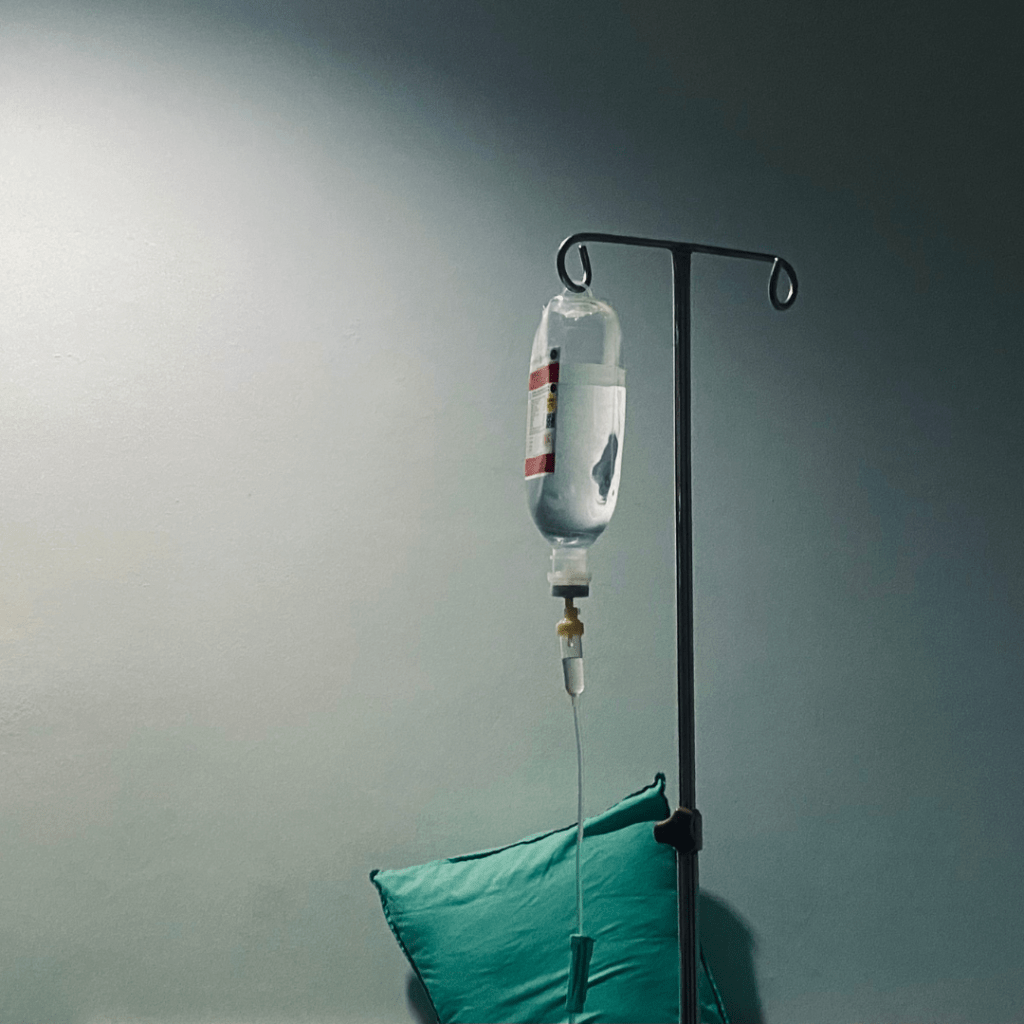
(This is a true story. It happened in a large hospital in the capital city of a state on the east coast and the events transpired so many years (decades) ago, that I feel confident nearly everyone involved is dead. I changed a few details (the actual room was, I think, on the 4th floor, but “six thirteen” has a ring to it). I have not bothered to change the names, but since I cannot remember one key player, I will call him “Charles.” The back story took place in Martha’s Vineyard as I recall, but it might have been one of the other quaint New England villages where the rich, famous, and over-educated summered.)
I was a pharmacy technician in the hospital’s in-patient pharmacy and one of my duties was to deliver drugs to the floors for nurses to administer to patients. I returned to the pharmacy, deep in the basement after a delivery one day, and found two pharmacists reading from a computer screen and shaking their heads. One asked if I’d been to the sixth floor.
“Yes,” I said. They looked to each other and then the screen. Then one switched to another display. They were clearly worried and unwilling to share information with me.
The next day, on my early afternoon delivery, I saw a short, middle-aged man, a patient in a gown, in the doorway of room six-thirteen. He was all smiles and so was the nurse he spoke to. I saw her cut their conversation, apologizing she had work to do, and as I passed he spoke to me. He seemed eager for company and was very friendly. He introduced himself and as I, by habit, paid no attention to patient’s names (confidentiality being important at the hospital), I instantly forgot it. He was gregarious, effeminate, had an unplaceable Southern accent (I am very good at identifying accents), and I remember I thought he reminded me a little of Truman Capote, but likable. Many, many, long years later, the actor, Leslie Jordan would come on the scene, and I can tell you this patient resembled him in appearance, manner and voice. Leslie Jordan’s accent though was distinctive, specific, and genuine. The patient told me his doctor was a genius, and the hospital “the best,” but so far “they haven’t figured out what’s wrong with me.” He seemed to be in excellent health and spirits.
Back in the pharmacy from that day’s run, bemused, I mentioned to a few technicians in earshot of a few pharmacists, that I’d met an odd character on the sixth floor. A pharmacist asked what room he was in and why I’d spoken to him. Technicians were not allowed to enter a room or converse with patients. “Six-thirteen,” I said, “and he was practically in the hallway buttonholing people to talk to.” One of the headshaking pharmacists from the day before overheard me and came over to ask how the patient seemed.
“Fine,” I said. This brought a facial reaction. I can’t remember if it was a raised eyebrow or frown, but my description of the patient definitely surprised the pharmacist.
We had a large staff in the pharmacy and two technicians were senior, a lead technician, an attractive blonde woman named Sheila, and an IT specialist, a young man named Scott, whom many of us went to with our work problems. I naturally went to both to ask what secret the pharmacists were keeping about the patient in room six thirteen. Each said they would pay attention and let me know what they discovered.
The next day when I made my third delivery, the patient called out to me from his doorway. I told him pharmacy techs couldn’t talk to patients but he waved that away and told me how much he loved art. He dropped the names of various and dispirit painters and sculptors.
When I ended my deliveries I was met in the basement by the two head-shaking pharmacists of day one, and they asked if I had seen the patient and asked my impression of him, of his health.
“Still fine,” I said, “as near as I can tell. I explained to him it was against the rules for me to talk to patients, but he talked away anyhow until I begged off insisting patients needed me to deliver their medicine on time.”
Later that day or night (we worked very long hours six, and seven days a week), Scott, the IT specialist, found me and said, “There is something fishy going on with that oddball patient on the sixth floor. He’s on…” and he named a drug new to me. There were two thousand drugs on the formulary and I knew a good many of them. “It is new and very rarely prescribed,” he explained.
Curiosity compelled me to breach protocol. I asked, “So what’s wrong with him?”
“It can theoretically be used for…” and like all drugs the list was long. The side effects list was long, too, and he told me that litany.
I am no doctor for sure, but with some assurance, I said, “He doesn’t have any of those problems.”
“What he’s got, or not got,” the IT specialist said, “isn’t the fishy part.” He handed me the drug’s report page and said, “Look at the recommended dosage.” I read it and he said, “The doctor is giving him three times the recommended limit.”
It was not unusual for pharmacists and doctors to have different opinions on what drugs, patients should receive. They also sometimes disagreed about dosage. Scott and I noted this and also, according to the drug report, the drug should not be given for more than four days.
The fourth day I made the delivery and the patient caught me in the hall, intent to impress upon me his passionate determination to succeed in his life’s dream of “taking art to poor children.” I was either meant to admire him for this or write a check in support. For a second we studied each other. If only there were a way for poor children to see art, I thought to myself and laughed. He inexplicably laughed with me. I backed up, waved, and broke away as he waxed mawkish on the subject.
In the pharmacy, a fellow technician, Roberta, approached me, apprehensive, and both excited and worried. She asked if I’d delivered to the sixth floor and when I said, yes, she struggled. Practically wringing her hands with worry and doubt, she in a whisper asked if I’d seen the patient in six thirteen.
She had my full attention. I said, “Oh, right, somebody turned me in for talking to him. It wasn’t my fault.”
“It’s not that,” she said. “I saw him today. I recognized him. I want your advice on whether or not I should go to the police.” We agreed to meet on our evening break, off the clock.
We found a private corner in the cafeteria and Roberta, still nervous and quiet, gave me chapter and verse. “Five years ago I was a waitress at Martha’s Vineyard. The man in six thirteen showed up in June calling himself five names, half were French, but he went by a title, The Duke of somewhere. He invited strangers to dine with him at the restaurants; mine included, tipped well, and got a room in the best hotel. He dressed well. He was a raconteur, an international flaneur. He was a name-dropper. People loved him and he got invited to all the parties that summer. He became a fixture in the village. Let me back up here. About a week after he first appeared, a jet-set guy with a boat captain hat called out to him at my restaurant like he was The Duke’s longest-lostest friend. They hugged and put on a show. The jet-setter, ‘Charles,’ was a loud talker and they traded reminiscences.”
The more Roberta talked the more nervous she got. I told her to slow down. She drank water and said she probably shouldn’t be telling me anything about him, discussing patients was a firing offense. She didn’t want to get involved with the police. I persuaded her to keep talking.
“The Duke dined out all summer, held court in conspicuous places, got invited onto yachts, and even day trips with families. The locals couldn’t get enough of him. Charles left and came back in July, then again in August, full of new stories. They talked about their friends and associates, big names, royalty. With all the feting he got there was no reason for The Duke to host dinners or parties at his hotel, or at my restaurant but he did. He was generous, ordered the best off the menu, and left big cash tips. Near the end of the summer, his bill was high enough to worry the hotel owner and his bill at the restaurant was hefty, too. The hotel owner told The Duke he would like for him to pay the summer’s bill. Of course the next morning The Duke was gone. The police worked every angle and could not find any trace of him, or Charles.”
“Oh definitely the police,” I told her. “Let’s call them now.”
“No.” She got upset. “Not now. I have to think about this.”
“Are you afraid he will recognize you?” I asked.
“Yes. Maybe. No. Not really. I look different.” Roberta had very short hair, wore no make-up, and when I’d seen her out of scrubs in street clothes she dressed shabby. I tried to imagine her five years younger with long hair, cosmetics, and dressed for big tips from wealthy New Englanders. It was easy to believe The Duke would not remember her.
“Tomorrow then,” I said. She looked like she might cry. “Let’s take this to Sheila. We can ask Scott for advice, too. He’s already suspicious of this guy.”
“Scott?” she asked surprised. “Why? What’s The Duke done?”
“It’s the medication,” I told her. “Scott showed me the product report and the dosage and duration are wrong.” I didn’t tell her the pharmacists were eyeing six thirteen as well.
The next day, I told Sheila I wanted to talk to her about the patient in six thirteen. I’d already been reported for talking to him. She was busy. An hour later, she found me before I could find her. She was as no-nonsense, and direct-to-the-point, as anyone could be. She’d worked as a nurse and in that job, and in this one, time was critical. She whispered, “The pharmacists believe his doctor is trying to kill him.”
It was a little bit of a shock, then it reminded me of a cartoon on a door in the sub-sub-sub basement, the caption: doctors bury their mistakes. Only this wasn’t a mistake, and then I remembered I was the one taking the drugs to the patient. The fifth day’s dose was on my assigned deliveries only two hours away. I took a deep breath. “We have to talk to Roberta,” I said.
“Don’t tell anyone,” Sheila cautioned. The Pharmacy was run by a triumvirate, two men and a woman. The woman was head and shoulders more intelligent and wise than the men. I’ll call her “L” in this recount of events. Sheila said, “L is on it. Leave it to her. I just thought you would want to know.”
“And I think you will want to know,” I said, “that Roberta knows him, the patient. She might even know a doctor’s motive for murder.”
Roberta was assigned to one of the hospital’s other pharmacies that day, unavailable, and I made the sixth-floor delivery on schedule. The nurse who received the drug frowned. “You don’t like that one?” I asked pointing to the pill.
She said, “We’re having to watch him take it. His doctor was here yesterday to make sure he didn’t spit it out.”
Again, I was not supposed to talk to patients or discuss them with nurses or doctors. I wanted to ask of course what illness called for this particular medication but I kept quiet. I was good at my job. The patient was at that moment entertaining someone in his room. I heard a woman laugh. I thought, Well at least he’s not dead. I wondered what the drug was doing to him.
That evening, those long hours again, I got Roberta and Sheila together. Roberta told her story and I reasserted that should call the police. Sheila said again that we should let L handle it. I liked L. I finally agreed. We all held L in the highest esteem.
The next day, L came through with stellar management as she always did. She called me, Sheila, and Roberta into her office. “I’ve been to the top,” she told us. “The hospital administrator shut me down. He says he is aware of the situation, that it is grave and serious and must remain secret. He told me to trust him and I’m going to do that… for now.”
Roberta filled L and Sheila in on details about the con artist and his accomplice. I asked L to confirm that I was to keep making the deliveries. I was, and I made them day six, day seven, day eight, and day nine.
Scott caught up with me in a hall to whisper, “The guy in six-thirteen is past toxic levels. I read the delivery schedule today. He’s still getting the drug.”
“And at an increased dose,” I said. I knew Scott already knew this. He had access to databases including patient files. Said files provided no information on the patient’s diagnosis, however, which was very unusual. They did inform Scott that the doctor ordered a regular regimen of tests. “The full gamut,” Scott said.
On the tenth day, after I’d not seen the patient at his doorway for a couple of days and noticed the door closed on my delivery, I gathered Sheila and Roberta and we went to L.
“What I know did not come from the Administrator,” she told us in her office. “The patient was known somewhere, somehow, in the past, perhaps even known by his doctor here, to have worked a scam where he faked an illness, entered a hospital for a specific drug, and spent a few weeks passing the pills on to a man who sold them on the black market. The patient is here as an indigent, living and being treated at taxpayer expense.”
“Charles,” Roberta said.
“Maybe,” L said. “Six-thirteen does have a regular visitor, a man.”
“But this drug is new and rare,” I said. “They would not have pulled this scam to get it.” I didn’t know what its black market value was though, so I asked, “Would they?” L shook her head. “This drug is the doctor’s doing and I believe I figured it out.”
“Murder?” Roberta asked.
“I’ll stop it before it comes to that,” L assured us. I’m still obeying the Administrator, who is clearly covering for the doctor.”
“Why?” Sheila asked.
“The doctor,” L told us, “has an association with the company that created and manufactures the drug.”
I was the slowest in the room. Sheila gave out an immediate “Ah.”
Roberta seconds later said, “Oh.”
“L,” I said, “I don’t understand.”
She explained, “This new, and rare drug, has very little human trial history behind it. I believe the doctor is carrying out his own, secret, illegal experiment to find out what the drug will do at levels well beyond the manufacturer’s recommendations.”
“How illegal is that?” I asked.
“Doctors have leeway,” L explained, “within limits, but this doctor is far beyond those. If caught he could lose his license.”
“And be immediately hired by the drug company,” Sheila said.
L nodded to agree. “The patient is being carefully monitored. The overdose is having effects, but so far they don’t appear to be life-threatening.”
“But the long-term effects…” Sheila began.
“Like I said,” L told us, “I’ll cut the drug off and confront the doctor if I’m not given permission to do so pretty soon.”
“Scott has been following this,” I said.
L sighed. “I’ll speak to him.” She named the two pharmacists I saw react to the patient’s computer file the day it all began. “I have kept them in the dark so far,” she told us. “They asked salient questions and asked me to look into it. They are trusting me, but it might not be too long before they come back to me to raise an alarm. Obviously this secret can’t go any further.”
We each assured her we told no one else.
“So if The Duke dies,” Roberta said, “he is just a fake name with some fake identification, untraceable, unknown, not missed by anyone, and the doctor knows this. No one will ever know it was murder.”
“We will,” L said. “The patient is probably a career criminal,” she added, “so there is always a chance he has a fingerprint file, but yes, as you say, no one would ask what happened to him.”
“He is charming enough,” I said. “Almost sure to be a sociopath. If he does die, the doctor might think he’s done the world a favor.”
“He won’t die,” L said. “Let’s follow orders for now and keep this secret. I spoke to someone on the floor in the strictest confidence of course…” ’On the floor,’ we all knew meant she had a nurse spying for her. “…and this case is raising suspicions there, so it really can’t continue much longer.”
I made the eleventh-day delivery. The twelfth was a lower dose, the thirteenth even lower. The drug was ended and the patient stayed on for observation. He looked older and tired when I saw him in his doorway. The smile was as big but it was pitifully false. He was drained. He engaged a stranger in conversation before I got that far down the hall so I was spared the art masterworks-for-starving-children spiel.
I never saw him again. L let me, Roberta, Sheila, and Scott know he was discharged in relatively good health after fifteen days at the state’s expense. I wanted him and his accomplice caught and prosecuted. Roberta wanted to forget them both, and L wanted to please the Administrator. As we left L’s office Sheila laughed and said, “It’s just one more strange adventure in this house of horrors.”
Author’s note:
The Northeast elite, secure in their superior command of literature and love of art, suffered for not having read so basic a classic as The Adventures of Huckleberry Finn. In that book, two characters, the Duke and The Dauphin, swindle and dupe and rob more than one small town. Their escapades expose Southern stupidity. In real life, Northern intelligentsia fell victim to the scam, which The Duke and “Charles,” appear to have lifted directly from the pages of Mark Twain’s most famous book. The Yankees fell for it hook line and sinker. I have no doubt The Duke and “Charles” dropped Twain quotes as hints and howled in private laughter when the clues passed over the heads of Martha’s Vineyard’s Ivy League graduates and maybe even a few professors.
J. Rawley was a freelance space journalist. He grew up in and currently divides his time between: Virginia, North and South Carolina, Georgia, and Southeast Florida. He spends as much of each year as he can in Jupiter with plutocrats.

 americanfirstmagazine.com
Leave a reply to mtherouxe9e096fa3f Cancel reply